Why Technology Still Cannot Replace Face-to-Face Interaction in the Workplace
The debate over remote work, hybrid schedules, and return-to-office mandates has generated more heat than light over the past few years. Having spent my career working directly with occupiers navigating office decisions, I can tell you that the data now confirms what most experienced business leaders already suspected: technology has made us more connected, but it has not made us more collaborative. There is a meaningful difference between the two.
The Return-to-Office Reckoning
The numbers no longer leave much room for debate. The latest KPMG CEO Outlook survey highlights a sharp shift in leadership sentiment:
- 83% of global CEOs anticipate a return to full-time office attendance by 2026, signaling a potential end to hybrid work models. This is up from 64% in 2023.
- 62% of U.S. CEOs envision the working environment for corporate employees whose roles were traditionally based in-office to be back in the physical workplace in the next three years, a marked shift from 2022 (34%).
- 87% of CEOs say they are likely to reward employees who make an effort to come into the office with more favorable assignments, raises, and promotions.
Amazon returned 350,000 employees to the office full-time in January 2025. JPMorgan Chase followed, ending remote work arrangements in April 2025. The federal government ordered all federal employees back to in-person work. These are not small experiments. They represent some of the largest employers in the world making a calculated bet on physical presence.
And yet, the story is genuinely more nuanced than “remote work is dead.” Emerging research suggests that structured hybrid arrangements, with three intentional in-office days built around collaboration and team interaction, appear to offer the strongest combination of focus and cohesion. Fully remote work persists and remains viable for certain roles. What the data is clearly rejecting is the idea that remote-by-default is a neutral choice with no tradeoffs. It is not.

Context Is Everything: What Video Calls Actually Cannot Do
We all appreciate the convenience and efficiency of texts,email and video call, Many business conversations are transactional by nature. They are focused on solving a specific problem quickly and efficiently. Business relationships, on the other hand, are built in the slower moments, when people take the time to share context, read the room, and learn something about the person across from them.
In my experience the most consequential insights, the ones that change the direction of a deal or unlock a creative solution, almost never emerge from a scheduled video call. They come from a walk down the hall, a conversation over coffee, or a casual exchange that happened to veer somewhere unexpected. That is not nostalgia. That is how trust and tacit knowledge actually transfer between people.
The intimacy and trust developed through face-to-face meetings are critical for transferring tacit knowledge, knowledge that is difficult to articulate. That observation holds up. Technology improves the efficiency of information exchange. It does not improve the depth of human understanding that forms the foundation of genuine problem-solving.
What “Collaboration” Actually Requires
The word “collaboration” is used so frequently in corporate environments today that it has lost most of its meaning. In practice, real collaboration is not a video call with your camera on. It is the kind of interaction where people pick up on hesitation, redirect a conversation based on body language, and build on each other’s thinking in real time.
An executive survey conducted by SHRM found that maintaining corporate culture and effective teamwork was the number-one challenge of remote work, ranking ahead of concerns about individual productivity. This is an important distinction. Remote work has proven reasonably effective at preserving individual output for heads-down, defined tasks. Where it consistently falls short is in the conditions that allow culture, mentorship, and institutional knowledge to take root and grow.
I see this play out in the tenant decisions I advise on regularly. Companies that went fully remote during the pandemic and stayed there are now grappling with a quieter but serious problem: their junior employees do not know how to read a client, their mid-level managers have never had to lead by example in a shared space, and their culture exists mainly as a set of values on a website. That is a real cost, even if it does not appear on a balance sheet.
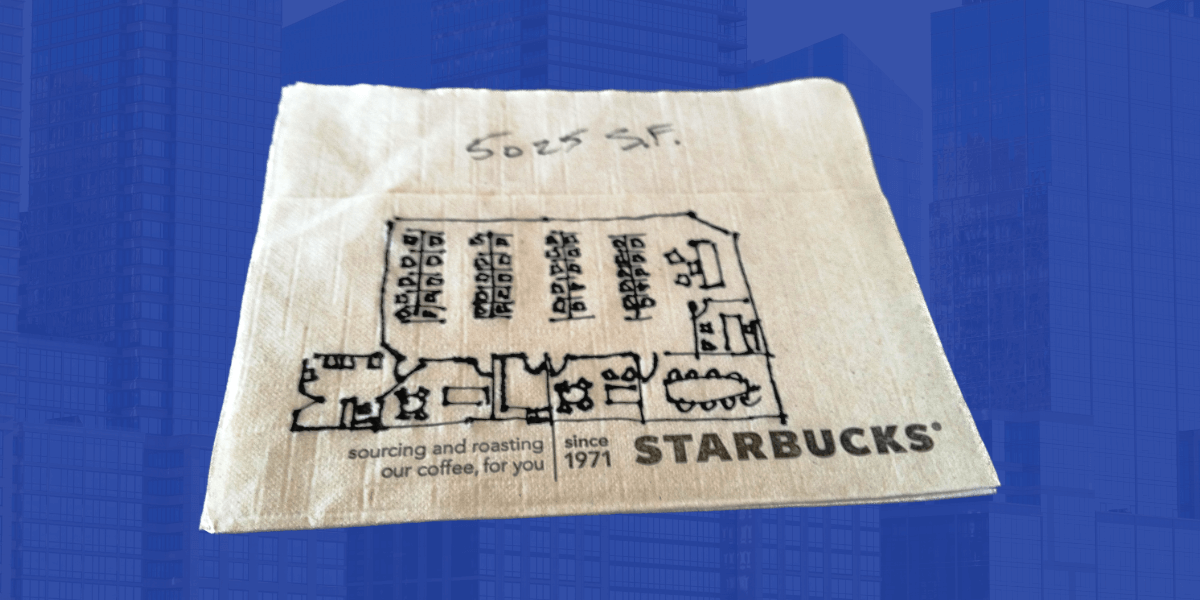
The Napkin Sketch Is Still the Best Business Tool
I am as willing to adopt new technology as anyone in this industry. The tools available today for virtual communication, project management, and data sharing are genuinely impressive and have changed how I work. I use them every day.
But the ideas that have most directly benefited my clients, the ones that reframed a leasing strategy, identified an off-market opportunity, or helped a company right-size its footprint before committing to a long-term obligation, did not come from a software platform. They came from conversations. Often informal ones. Frequently scribbled on whatever was nearby.
Technology creates the infrastructure for connection. In-person interaction is where connection actually happens.
Physical Presence and the Culture Question
Beyond solving immediate problems or generating ideas, in-person work does something that no remote arrangement has demonstrated an ability to replicate at scale: it builds organizational culture through shared experience. Shared meals, impromptu hallway conversations, and the accumulated texture of daily proximity create a sense of belonging that shapes how people work together over time.
This is not a soft consideration. It is a strategic one. The companies I work with that have the most cohesive teams, the strongest retention numbers, and the most productive cultures are not the ones with the most sophisticated remote work policies. They are the ones that have been intentional about when, why, and how their people come together in person. The office, in that sense, is not just a cost to be managed. It is an investment in the conditions that allow a business to function at its best.
Whether a company is evaluating a new lease, rightsizing its current footprint, or rethinking its entire workplace strategy, the question of how and where people work is inseparable from the question of how the organization performs. That is what I bring to every engagement, not just square footage and lease terms, but a clear-eyed view of how space serves the people who use it.
Frequently Asked Questions
Q: If most of my team is productive working remotely, why should I require them to come into the office?
Individual output holds up reasonably well remotely. What erodes quietly is mentorship, institutional knowledge, and the trust needed to navigate complex decisions together. Research shows corporate culture and teamwork are the primary casualties of long-term remote work, not individual productivity. That cost is real even when it does not show up on a balance sheet.
Q: How should companies determine the right balance between in-office and remote work when making office space decisions?
Research points to structured hybrid models, three in-office days organized around collaboration rather than heads-down work, as the strongest performer for knowledge-based teams. From a real estate standpoint, getting that balance right before signing a lease has significant implications for how much space you need, how it should be configured, and what flexibility you should negotiate for.